Massage for Back Pain: What It Helps With
Author
Anna
Back pain almost always arrives the same way: first it is "just tired", then it pulls between the shoulder blades, and a month later turning your head is awkward. Massage for back pain is one of the first tools people reach for, and it works for perfectly logical reasons. Here is what it helps with — and where a doctor comes first.
Why a desk day makes your back hurt
A muscle held in one position never really rests — it stays in a constant low-level contraction. Over time tight spots appear, blood flow in the area drops, and the brain starts reading discomfort. Hence the familiar picture: a nagging lower back by evening, concrete shoulders, a heavy neck and tension headaches.
With a diagnosis like degenerative disc changes, another layer appears: the body adapts around the discomfort and overloads the muscles surrounding the problem area. That muscular tension is exactly what massage works on.
What massage helps with — and what it does not
It helps:
- release muscle tension and spasm;
- restore mobility in the neck, shoulders and lower back;
- improve blood flow in a tight area;
- reduce the background discomfort of desk work.
It does not replace:
- diagnosis and medical treatment — structural changes in the spine are not fixed by hands;
- therapeutic exercise: without movement the tension comes back;
- a doctor's visit for sharp pain, or pain radiating into an arm or leg.
Put simply: massage is good at the consequence — muscle tension — but it does not remove a cause that sits in a diagnosis. So the sensible order is a doctor first, then massage as supporting care, not instead of it.
Which massage to book for your area
| What bothers you | Format |
|---|---|
| Lower back, whole back, "tired of sitting" | Back massage |
| Neck, shoulders, tension and headaches | Neck, shoulder and head massage |
| General stiffness all over | Full body massage |
| A back loaded by training | Sports massage |
The most common request in Batumi is neck and shoulders: a laptop, air conditioning and a backpack on one shoulder give a predictable result.

How a session goes
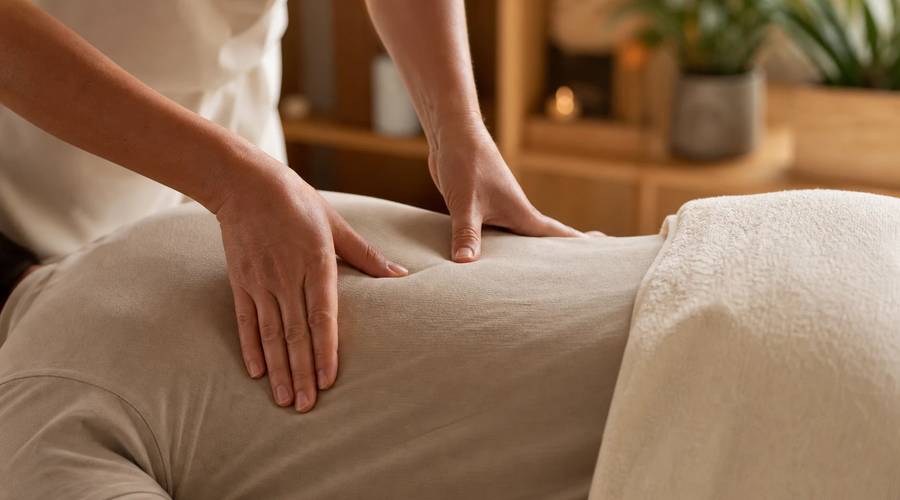
An hour, face down on the table. The therapist warms the muscles up with broad strokes, moves on to deeper work on the tight spots, and finishes with relaxing movements. It should feel firm but tolerable — sharp pain has no place here, so speak up about discomfort and the pressure gets adjusted.
Mild muscle soreness the next day, like after a workout, is normal and passes in a day or two.
How many sessions you need
One session is usually enough to feel better, but not enough to keep the tension from returning. A working plan: a course of 5–10 sessions, once or twice a week, then a maintenance session every two to four weeks. Between courses what holds the result is habits — breaks from your desk, neck mobility work, a monitor at the right height.
When massage is off the table
Skip it with acute pain of unclear origin, a fresh injury, fever, inflammation, or during a flare-up when any touch to the area hurts. Cancer, thrombosis, serious heart conditions and pregnancy are separate conversations with your doctor.
Backs respond to consistency far better than to heroic one-off sessions. One hour every week or two, and you feel the difference in how you get up from your chair at the end of the day.